
When We Tried to Build It
The Economy Is the Message, part two

Two days ago I wrote that the economy is the message. That in Web3, the way value moves is not bolted onto the song after the fact, the way it is in Web2. It is part of the song’s form, from the first chord. I gave one small piece of evidence: a tip Karo Glazer received on Orb for twenty cents, for a post she made with no expectation of being paid anything at all. The system rewarded her without being asked to.
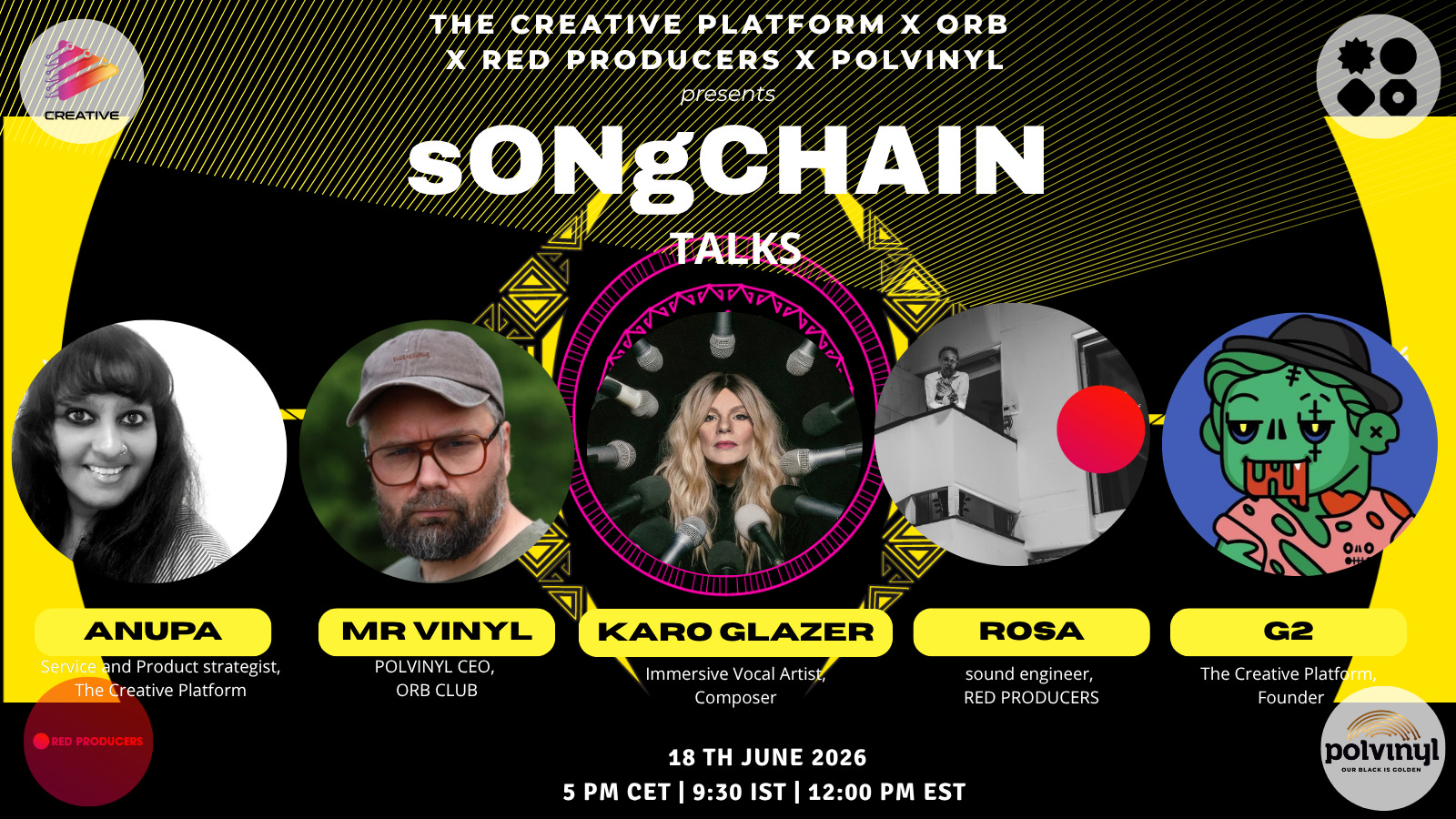
This afternoon we ran the first SongChain Talks, a Twitter Space, to talk about that idea publicly for the first time, with the people we’ve been building it with. What came out of that conversation made me want to write the second half of the story immediately, while it’s still fresh: not the theory, but what it actually looks like when you try to build a system like that on purpose, instead of just noticing it works by accident.
This is the story of what happened when we tried, told mostly through what we said out loud this afternoon.
A voice with no edits
It starts, as most things in this story do, with Karo.
She had come back from a conference, the kind where everyone talks about AI and nobody talks about music. Around the same time, two of her artists, one in the UK, one in Germany, released their debut songs. Different countries, different sounds, same reaction from radio promoters: did AI write this for you?
Both artists were devastated. Not because the comment was unfair exactly, but because it revealed something about where the industry’s attention had gone. Nobody was asking if the song was good. They were asking if a human made it.
Karo’s conclusion was simple and, I think, correct: the only thing left that unmistakably proves a song is human is the voice. Not the production, not the arrangement, the voice, raw, unedited, unprocessed.
So she did something most artists would never do. She released a piece of her own voice with no music behind it, no editing, no polish, and called it seed zero. Not a song. A starting point. An invitation for other people to build something using nothing but that voice as the seed.
We were somewhere in one of many conversations, the kind where you’re just talking through ideas without a plan, when I said songs on chain and then songchain, and it stuck. That was it. Not a strategy session. A name landing in the middle of a sentence and both of us knowing immediately it was right.
Karo had her own addition: if there is a seed song, the starting point she called layer zero, then there must also be a fruit. The result of everything that grows from that seed. She called it sONgFRUIT.
That is how SongChain started. Not as a business plan. As a reaction to a world where a great debut gets questioned instead of celebrated, and a name that arrived uninvited in the middle of a conversation.
The problem with a simple idea
The first version, what we now call sONgfruit_01, was meant to be straightforward. Take the seed, let artists add layers, one at a time, end up with a finished song, press it on vinyl, attach an NFT, done.
It turned out to be harder than that. Collaborative songwriting is a specific discipline, and working inside a structure where your contribution has to leave room for everyone else’s is not how most musicians are used to thinking. Whether that was a communication failure on our side, or simply the nature of the task, or both, we’re not sure. Probably both. What we understood from it is that real creative freedom comes from constraints, not from the absence of them, and that those constraints need to be communicated clearly before anyone starts, not explained after something goes wrong.
So when we started building toward a second version, the question stopped being purely creative. It became legal, technical, and uncomfortably specific. Who owns what. Who can claim to have made what. How does anyone get paid when there are ten contributors instead of one. What happens to a song under a system, like Spotify’s royalty structure, that was never designed to recognize more than a handful of credited artists.
Meeting the people building the other half
A few weeks into wrestling with those questions, I met G2 and Anupa, who run Creative Platform. We’d been circling similar problems from different angles, his being the tools artists use to make and protect their work, mine being the physical and social infrastructure around a song’s release. We started talking. The talking turned into building, and it’s still going.
G2 said something on today’s call that stuck with me: the rights organizations that still govern how music royalties are split, BMI, ASCAP, the structures behind them, were built around 1920 and have not meaningfully changed since. We are trying to build something new on top of infrastructure that was never updated for a world where ten people might reasonably claim a share of one song, where the same piece of music might earn money across a film, a game, a TV placement, and a stranger’s Instagram reel, all in the same month.
There is no single fix for that. We’re not pretending there is. What we found, instead, is a slower path: build the smallest version that works, watch where it breaks, fix that piece, repeat. No roadmap. We say, half-jokingly, that it’s better to ask forgiveness than permission, because waiting for a fully resolved answer to every legal question would mean never starting.
What the tip actually proved
I want to come back to that twenty-cent tip, because I think it’s still the clearest piece of evidence we have for the whole argument.
Karo posted something on Instagram and on Orb, the same content, more or less. On Instagram, nothing happened, the way nothing usually happens. On Orb, a stranger tipped her. Small amount, no fanfare, but real. Nobody asked them to. The platform’s economy simply moved in her direction because the system is built so that appreciation can become value without a campaign, a call to action, or a sales pitch.
That is the difference I keep trying to describe. In Web2, the economy is something you build on top of your content, separately, painfully, usually badly. In Web3, when it’s done right, the economy is underneath the content from the start. It doesn’t need your permission to work. It just works, or it doesn’t, depending on whether the system was built with that intention from day one.
SongChain is our attempt to build something where it works on purpose, not by accident.
Who this is actually for
We’ve been clear, maybe more than people expect from something this new, about who we want involved.
Not hobbyists experimenting for a weekend, though there’s nothing wrong with that, just not what this is for. We’re looking for people who treat music as something they’re building a life around. Karo put it better than I can: to write one great song, you need to write a hundred. We want the people already in the habit of writing the hundred.
We’re also, deliberately, looking for people who aren’t musicians at all. Mentors. People with legal knowledge, industry experience, the kind of hard-won understanding of how rights and royalties actually move through the real world. People willing to teach, not just create.
The vinyl world and the digital world rarely talk to each other, even though they’re more connected than either side admits. We want the people willing to stand in both rooms at once.
Where we are now
We’re early. Genuinely, uncomfortably early, in the sense that most of what we’ve described above came from finding more problems than we solved. Season one happened a few months ago and was, in our own words, bare bones. We’re building Season two with Creative Platform now, and ahead of the full contest, we’re running something smaller called Song Cup, a low-stakes, World Cup-themed warm-up to test the mechanics before we ask anyone to take it seriously. Neither has launched yet. Both are close.
Here is the part that I think matters most, and the part that the tip story was always really about: the platforms we’re building on, Lens, Orb, Creative, are not hypothetical. They exist. People are already there, already tipping, already collecting, already building identity that travels with them instead of disappearing into an algorithm’s mood. The economy is already running. We didn’t invent the mechanism. We’re trying to point it, on purpose, in a direction that serves the people making the music instead of the platform extracting from them.
That’s the whole project, really. Not a new invention. A different intention, applied to something that was already quietly working.
If you want to follow where this goes, or be part of building it, find us on Orb at @songchain. Season two and Song Cup are both coming. We don’t have a finished map yet. That’s still the point.
If you missed this afternoon’s conversation, you can listen back here.